The Code Review is dead
.summary {The ritual where a colleague reads every line you wrote before it's allowed anywhere near production — is dead.
It just hasn't noticed yet, and most of us are still turning up to the funeral out of politeness.
} .category {Personal
} }Be honest. When did you last properly review a pull request? I don't mean skimming the diff, scrolling to the bottom and typing "LGTM". I mean pulling the branch, running it, and actually thinking about what it does.
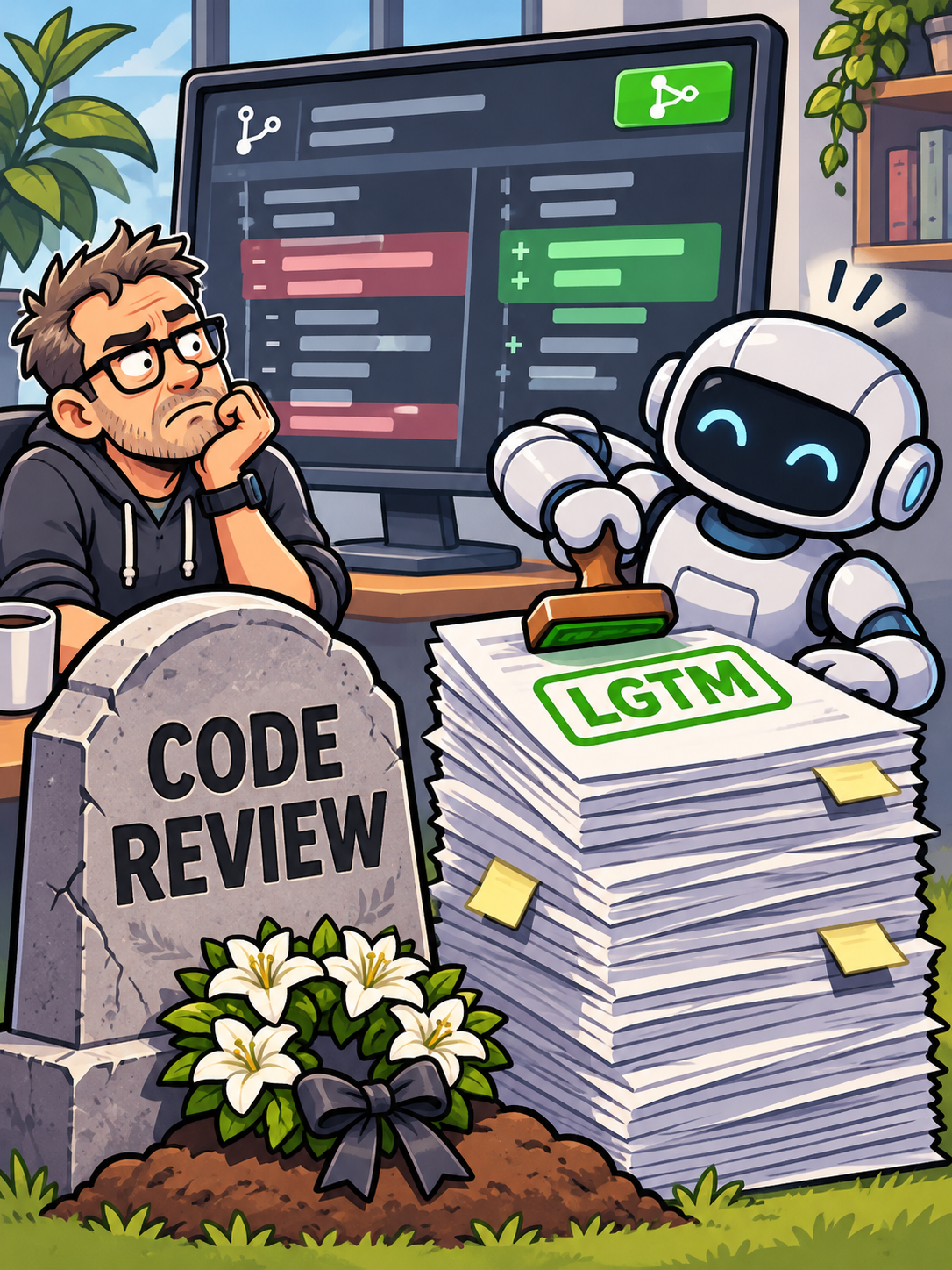
If you had to stop and think about that, you're not alone. Code review — the ritual where a colleague reads every line you wrote before it's allowed anywhere near production — is dead. It just hasn't noticed yet, and most of us are still turning up to the funeral out of politeness.
That's not entirely a bad thing. But it's worth being clear about what we've lost, and what has quietly taken its place.
What code review was actually for
Code review was never really about catching bugs, even though that's what we all said it was for. Ask a team why they do it and you'll get some mix of these:
- Catching bugs. It does catch some. Mostly typos, missing null checks and the odd off-by-one. The nasty ones — race conditions, a bad assumption about how a third-party API behaves — sail straight through.
- Sharing knowledge. Someone other than the author now has a rough idea how the payments module works.
- Keeping things consistent. We don't do it that way here" is a review comment that has saved many a codebase from becoming five codebases.
- Mentoring. For juniors, review comments were often the best teaching they got all week.
- Accountability. Two names on a change. If it goes wrong at 2am, at least you're not alone.
How it died
There wasn't a single killer. It was more of a slow pile-up.
The volume went through the roof. With an AI assistant in the editor, one developer can produce more code in an afternoon than they used to write in a week. Nobody gave reviewers the same upgrade. Writing got cheap; reading didn't. Review became the bottleneck, and bottlenecks get routed around.
The pull requests got huge. There's an old joke: ask someone to review ten lines and they'll find ten problems. Ask them to review five hundred and they'll say "looks fine". Generated code has pushed a lot of PRs well past the five-hundred mark, and nobody is reading a 2,000-line diff line by line. They're scrolling.
The author didn't write it either. Review used to be one person checking another person's thinking. Now the reviewer is often checking code the author only half read before pushing. That's not two pairs of eyes. It's two people nodding at a machine.
Then the bots turned up. Plenty of teams now have an AI reviewer leaving comments on every PR. So we have code written by an AI, reviewed by an AI, with a human in the middle whose main job is clicking the green button. That isn't review. It's ceremony.
What's replacing it
The good news is that the jobs code review used to do haven't disappeared. They've moved somewhere else, and in a few cases somewhere better.
Tests are the real gate now. If a human isn't reading every line, the test suite has to. A PR with solid tests and no reviewer is safer than a PR with a reviewer and no tests. If you can't trust your tests, no amount of "LGTM" will save you.
Machines handle the nitpicks. Formatting, naming, unused imports, type errors: none of that should ever need a human comment again. In PHP land that means Pint or PHPStan cranked up to a high level, and a CI pipeline that fails loudly.
Production is the final reviewer. Small deploys, feature flags, good logging and a rollback you've actually tested. The question changes from "is this perfect?" to "will we know quickly if it isn't, and can we undo it?"
Review the plan, not the diff. Ten minutes talking through the approach before any code exists catches more real problems than an hour reading the result. Pairing does the same job in real time.
Ownership. Whoever merges it owns it. That concentrates the mind far more than a second name on the PR ever did.
What we lose, and what's worth keeping
Remember that review was mostly about understanding, not bugs? That's the bit we're really losing. Tests and linters won't tell the rest of the team how the invoicing logic works. When the one person who "wrote" it leaves, you find out nobody else ever read it. Juniors lose out too: a bot's comment isn't the same as a senior dev explaining *why* we don't do it that way.
So I don't think we should cling to the old ritual, but I wouldn't bin all of it either. Here's what I'd keep:
Proper human review for the scary stuff. Authentication, payments, database migrations, anything touching personal data. If it can lose money or leak data, someone reads every line. No exceptions.
Read the tests first. If time is short, review what the change is *supposed* to do rather than how it does it. Good tests tell you both.
Keep PRs small. Generated code makes it easy to ship a monster. Don't. Small changes are still the only ones anybody will genuinely read.
Make knowledge sharing deliberate. If review isn't spreading understanding any more, something else has to: a quick walkthrough, a short write-up, rotating who works on what.
So, is it dead?
The version where a human reads every line of every change before it ships? Yes. Honestly, it was on life support for years before AI came along. We just got very good at pretending.
What should survive is the conversation: people talking about what they're building and why, before and after the code exists. That was always the valuable part. The diff was just where we happened to have it.
Page updated: 2026-11-20